

Does AI recommend your products?
Perform a free audit.
AI Engine Optimization (AEO) 2025
AEO is the new standard for e-commerce visibility and sales.
Why is AEO so important for your online store?
- AI takes over traffic from search engines. AI (AIO) responses already appear for a large proportion of e-commerce queries and generate significant traffic
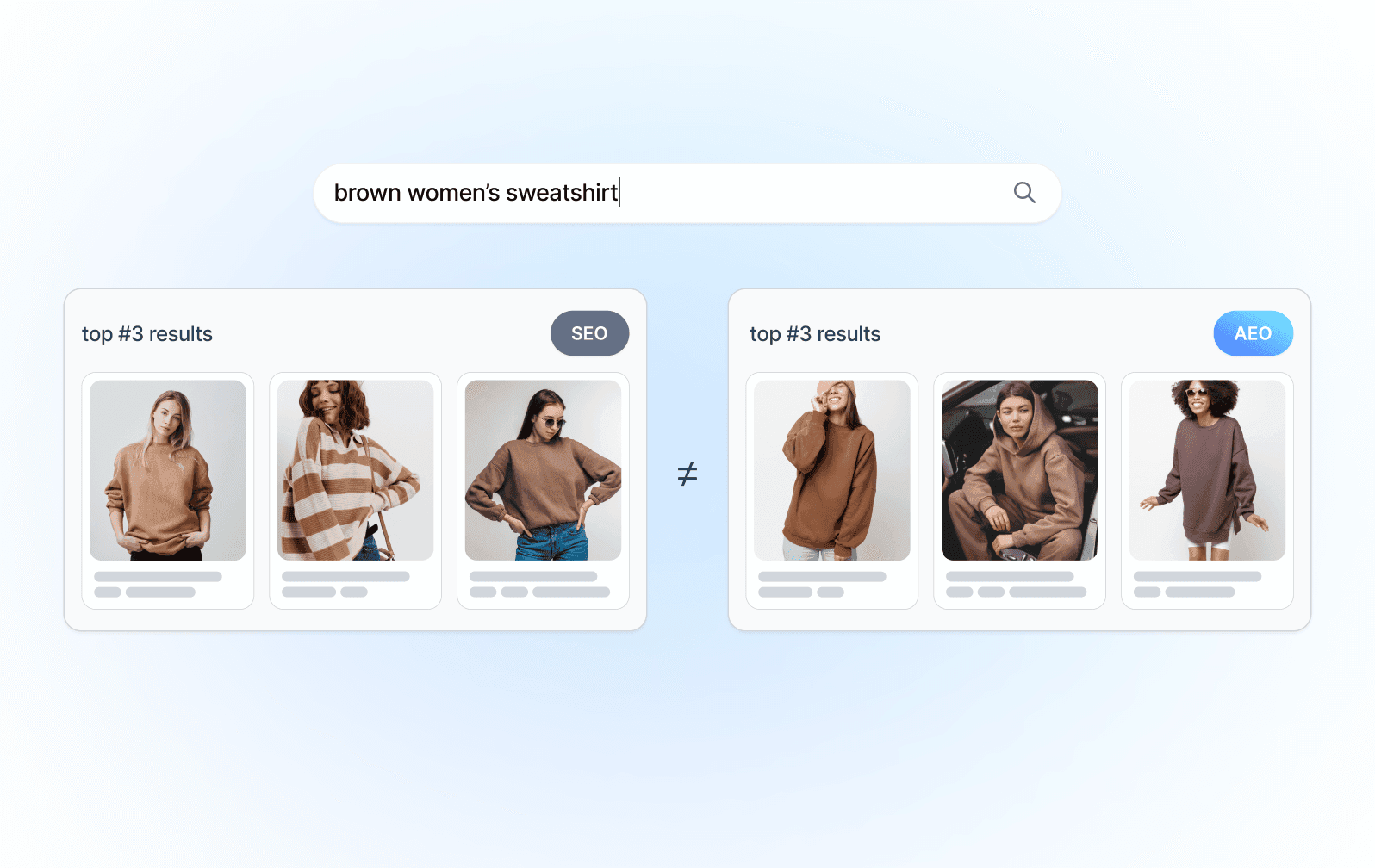
- Top 1-3 on Google is not enough. Only a fraction of these items make it to AIO, and most of the sources in AIO do not coincide with the classic TOP3 SEO
- Talk sells. Purchasing via chat/voice/AI is hundreds of billions of dollars a year - it's a viable revenue channel, it's the present day
- Personalization = money. In leaders, recommendations/personalization yield ~35-40% of revenue
- Polish practice. On average, 6% of traffic from AI chats can generate as much as 14% of revenue (case Semly)
- Conclusion: add AEO alongside SEO + Prepare data, push offer to ChatGPT/Gemini and measure share of sales with AI
What to do now?
- Arrange product data
- publish them to LLM ecosystems
- enable shopping assistant
- measure visibility in AI and revenue impact
Why isn't SEO enough anymore?
- AI shortens the path user, ignoring classic organic results (80% of sources in AI Overview are not SEO leaders)
- 77% of e-commerce managers use AI on a daily basis for campaign automation, analytics, recommendations and personalization
- 29% of retail companies are already building an edge based on big data and insights from AI - better forecasting, inventory, rapid response to trends
- Zero-click is growing and OSR (Organic Search Revenue) is flattening out; regulatory pressure around AIOs in the EU confirms the scale of the phenomenon
What does it realistically command in AEO?
- Share of AI Visibility (SAV): percentage of queries in which the brand appears in AIO/LLM. Today, the "new 1st page" on Google
- Conversation-assisted revenue: revenue share where the first touch is chat/LLM (attribution based on parameters and post-purchase surveys)
- Time-to-Answer (TTA) and Answer Quality Score: latency and completeness of responses (FAQ, price, availability, returns)
- Retention & AOV uplift supported by personalization - confirmed by mcKinsey meta-analyses
- Conversational GMV - growing pie ($290 billion), so even a small share equals material revenue
AEO architecture - from data to visibility
Product data layer
- Canonical feed Google XML + JSON Lines for LLM (keys:
productTitle,brand,gtin,mpn,sku,description,price.value/currency,availability,imageUrl,url,shipping,returns,country,language) - Normalization of units (ml/g/cm), variants, bundles, compatibility with schema.org/Product (JSON-LD)
- Freshness SLA: prices/states min. every 15-60 min. (LLM prefer up-to-date)
AEO-ready content layer
- Descriptions based on intention and use-cases (complete answers, not phrases)
- FAQ/Q&A per product/category (short answer + source)
- Polyglot: same entities (Brand, GTIN) and thesaurus phrases in EN/EN/DE/ES
Trust signals layer
- Reviews (number, freshness, rating), return policy, warranty, local states (LIA), transparency of delivery
Publishing layer to AI ecosystems
- Ingestion endpoints for ChatGPT/Gemini/Perplexity (feed pull / webhook push)
- Category mapping (Google Product Taxonomy) + custom ontology
- Safety & rights: robots/LLM-allow, source policy, UTMs for attribution
Conversational layer
- Purchasing assistant (chat/voice) with grounding in the feed (retrieval), access to prices/states and policies
- Handover to checkout or cart in 1 click (deep link, schema app links)
Observability
- Telemetry: SAV, CTR-to-site with AIO/LLM, % of responses with correct price/stock, change indexing time, inferred share of recommendations
Data from the Polish market
- Example of a children's goods store - AEO implementation (via Semly) translated into increase in the number of product inquiries in AI models by 130% m/m and an increase in the conversion rate in this channel by 18%
- Lighting store: the appearance of products in the "See products" section of Google Gemini gave +25% of the value of the average basket
- Clothing stores: users using personalized AI recommendations spend 30% more time on site, which directly translates into higher conversion rates
How to measure AEO - definitions of KPIs
- SAV @Top Answer = branded queries in the "main" response / all monitored queries
- Coverage in AIO/LLM = #indexed SKUs in models / #SKUs in feed
- Answer Accuracy (price/status) with sampling every N hours
- Conv-assist rate = orders with first touch LLM - chat / all orders
- mCAC(AI) = (tool cost + ops) / orders assigned to AEO
- Uplift AOV/CR in "with chat" vs "without chat" cohorts
30-day implementation plan (battle-tested)
- Day 1-5: data audit (GTIN/MPN/brand completeness ≥ 95%), schema consistency, JSON-LD + JSONL preparation
- Day 6-10: "Answer packs" for top 100 queries (description, FAQ, parameters, 2-3 comparisons of alternatives)
- Day 11-15: publication to LLM (ChatGPT/Gemini) + attribution routing (parameters, post-purchase survey)
- Day 16-20: shopping assistant (chat) with grounding and policies (returns/delivery/pricing)
- Day 21-25: freshness tests (price/status), validation Answer Accuracy > 97%, tests (no SKU, no variant)
- Day 26-30: tuning prompts, organizing categories (taxonomy), dashboard KPIs (SAV, Conv-assist, AOV uplift)
Conversational Commerce and AI's contribution to sales
Global spending on conversational commerce (shopping "via chat," voice, AI) will exceed $290 billion in 2025. For Polish stores, the implementation of AEO by Semly already results in an average of 6% of traffic comes from AI chatbots (ChatGPT, Gemini), responsible for as much as 14% of the store's revenue.
Anti-patterns (most common mistakes)
❌ "Rewriting" SEO-content to AEO 1:1 (too slow, inadequate)
❌ None canonical source of truth (price/state) visible to LLM → price hallucinations
❌ FAQs written with marketing instead of concise answers (LLM prefers unambiguity)
❌ No SAV/Accuracy metrics → no feedback loop or optimization
Glossary (AEO 2025)
Basic
- AEO (AI Engine Optimization) - the process of preparing product data, content and trust signals and publishing them to LLM ecosystems and search engine generative layers to increase visibility and sales from AI responses
- AIO (AI Overviews) - google module that generates summarized AI responses to queries (former SGE/AI Snapshots)
- LLM (Large Language Model) - a large language model (e.g., ChatGPT, Gemini) that generates answers based on knowledge and external sources
- Conversational commerce - sales initiated or conducted via chat/voice/AI-assistant
Metrics and KPIs
- SAV (Share of AI Visibility) - share of queries in which the brand appears in the main AI response:
SAV = (# of queries with visibility in AIO/LLM) / (number of monitored queries) - AIO/LLM Coverage - catalog coverage in models:
Coverage = (# of SKUs visible in AIO/LLM) / (# of SKUs in feed)
- Answer Quality Score (AQS) - percentage of AI responses consistent with price/status/policy in control samples:
AQS = (# of correct answers) / (# of verified answers)
- TTA (Time-to-Answer) - time from inquiry to complete response/handover to cart
- Conv-assist rate (CAR) - share of orders in which the first touch was LLM/chat:
CAR = (# of orders with 1st LLM touch) / (all orders)
- mCAC(AI) - the marginal cost of acquisition through the AEO channel:
mCAC(AI) = (cost of tools + ops + AEO content) / (# of orders assigned to AEO)
- Conversational GMV - the value of sales from sessions with conversational interaction
- AOV (Average Order Value) - average order value
- CR (Conversion Rate) - conversion rate
- CAC (Customer Acquisition Cost) - customer acquisition cost
- ROAS/ROMI - return on advertising expenses / marketing investment
- OSR (Organic Search Revenue) - revenue attributed to organic traffic from search engine
Data and formats
- Google XML Product Feed - standard bid file for Google Merchant (expandable under AEO)
- JSON-LD (schema.org/Product) - structured data in a page (
Product,Offer,AggregateRating,FAQPage) - JSONL (JSON Lines) - linear record format (1 product = 1 line) useful for LLM supply
- GTIN/EAN, MPN, SKU global commodity identifier / manufacturer part number / store stock identifier
- Freshness SLA - guaranteed price/status refresh rate (e.g., ≤60 min)
- Answer Packs - short, unambiguous answer blocks (description + 2-3 parameters + source) that LLM can quote 1:1
- Product Knowledge Graph - entity graph (products-brands-parameters-categories) combining identifiers and attributes
AI implementation
- RAG (Retrieval-Augmented Generation) - generation with attached search/retrieval from authoritative store data
- Grounding - "Ground" AI responses in current, trusted sources (feeds, policies, states)
- Embedding - vector representation of text/data used for quick matching of content and products
- Ingestion endpoint - feed pickup/download point through AI ecosystems (pull API, webhook push)
- Taxonomy/Ontology - dictionary of categories and relationships (e.g. Google Product Taxonomy + custom extensions)
- LIA (Local Inventory Ads) - local availability signals (state in stationary store) useful also for AEOs
Attribution and analytics
- UTM - link parameters for source/medium/campaign tracking (e.g. utm_source=chatgpt)
- Post-purchase survey - a short post-purchase survey to validate the impact of AEO ("Where did you first hear about the product?")
- Deep link - link directing directly to the basket/specific variant with attribution parameters
- Handover - controlled transfer from AI assistant to checkout path (e.g., shopping cart with pre-filled SKU)
- Zero-click - the situation in which the user gets the answer without going to the page (especially in AIO/LLM)
- LLM-allow/robots - access policy (robots.txt / meta) clearly allowing selected agents/LLMs to retrieve data
- Observability - a set of logs, indicators and synthetic tests to monitor the visibility, freshness and relevance of AI responses
Share:
