

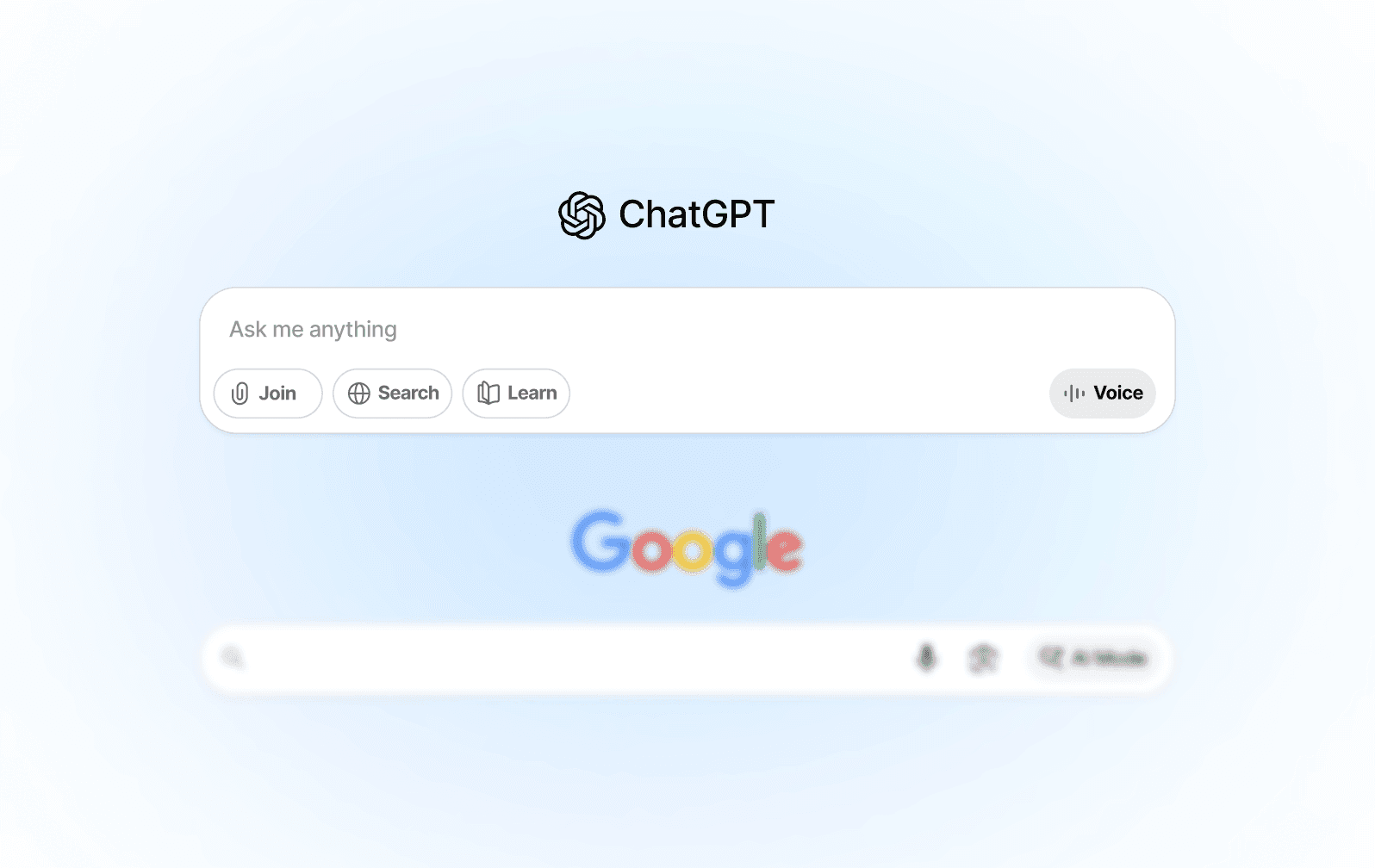
Does AI recommend your store?
Perform a free audit.
AI assistants
- ChatGPT Scale: by Business Insider, OpenAI reported ~700 million MAU (July 2025) and ~800 million weekly users in the fall of 2025
10% of adults worldwide use ChatGPT
Business Insider, quoting Sam Altman
- Perplexity Scale: service has processed ~780 million inquiries in May 2025, and active users reach ~22 million
Conclusion: buyers increasingly start with AI, rather than from a traditional SERP. If your assortment isn't "understandable" to LLMs and doesn't show up in their citations, you're missing out on a new stream of demand.
Google rebuilds search around AI
- AI Overviews is a billion+ users: Google announced global AIO rollout in 2025
Hundreds of millions of users this week, and more than a billion by the end of the year.
Google Blog
- AI-only test mode: in 2025, Google tested "AI Mode" - view without the classic "blue links" (for One AI Premium subscribers)
- Fewer clicks, more responses on the SERP: pew study: users are less likely to click links, when the AI summary appears. Other reviews indicate CTR drops of the order of 34-46% in the presence of the AIO
Conclusion: zero-click traffic is growing. The goal becomes to be a source in AI response, not just ranking in the top 3.
Marketplaces introduce their own "shopping assistants"
- Amazon Rufus: is a generative shopping assistant trained on Amazon's catalog, reviews and web information - first US, then beta in major EU countries (2025)
- Shopify Sidekick: assistant for vendors, publicly expanded in 2025/2026
Conclusion: product decisions are made in AI chats and cards. Stores need to feed these systems with clean product data and easily quotable content.
Product data and identifiers (GTINs) are the "fuel" of visibility in AI
- Structured Product Data: Google recommends full markups (merchant listings, variants, policies) because they make it easier to understand the offer and richer exposure
- GTIN/GS1: Google and GS1 emphasize that correct GTIN increases relevance and coverage; products with GTINs but shipped without GTINs may have limited visibility
Ensuring correct GTINs gives the best results and user experience.
Google Merchant Center
Conclusion: without correct GTINs, JSON-LD and a consistent feed LLMs have less certainty, to cite your site as a source.
Personalization and conversation = real profit
- McKinsey: personalization usually gives +10-15% of revenue (as much as 5-25% depending on industry and execution)
- Deloitte 2025: 53% of consumers already using or testing Gen-AI; share growing year-on-year
Application: conversational experiences (FAQ, Q&A, configurators, live answers) shorten the path to the basket - as long as the model "sees" full, reliable data of the product and conditions.
AEO/GEO is the new visibility playbook
- Definitions and practices: AEO/GEO is an optimization for quoting in AI responses (ChatGPT, AI Overviews, Perplexity, Copilot), not just link rankings. 
- Paradigm shift:
Traditional search was based on links; GEO is based on language.
a16z
- The black side of GEO: media warn of content manipulation under LLM - sources and verifiability needed
Conclusion: content wins clear, quotable, sourceable and embedded in patterns that the models can extract without fail.
It's not a trend it's a change in shopping habits
- AI's impact on shopping: in the IAB study (2025) AI is #2 source of influence on purchase decisions after search engines; 1/3 of users click to store directly from AI platform
- Readiness for AI shopping: some consumers are already willing to allow AI to buy on their behalf, acceptance of recommendations is growing
Conclusion: advantage you will build, simplifying decisions (comparisons, "best for...", free delivery thresholds, return policy) in quote-ready form.
AEO/GEO for e-commerce: 30-60-90 days of implementation
Days 0-30: the foundation of data and technology
- Schema.org Product (JSON-LD) on all cards: name, description, image, brand, gtin, sku, offers (price, availability, delivery), variants
- Product Feed (Google XML) = single source of truth for pricing and inventory; compatibility with Merchant Center
- Policies and conditions in format for machines: separate, readable URLs (delivery, returns, warranty) + Organization in JSON-LD
- Robots & crawlers: decide whether you allow GPTBot and other AI bots; control via robots.txt/firewall (allow/deny)
Days 31-60: content "to be quoted"
- Q&A/FAQ buyer-intent on categories and products: full sentence questions, short answers with numbers (delivery in X days, return Y days, compatibility Z)
- Comparisons and "best for...": tabular sections (parameters, usage scenarios) - models like structure and unambiguous attributes
- Evidence and sources: where possible, link to research/standards (e.g., GS1, manufacturers, certifications)
- E-E-A-T: authors, bio, update dates, content version number; brief TL;DR and Key facts early
Days 61-90: visibility and measurement
- Citation monitoring: check, whether and how AI is quoting you (Perplexity - list of sources in response; query tests)
- A/B micro experiments in "answer-first" content (headline → 2-3 sentences → punctuated facts → source
- Onsite personalization (recommendations, dynamic Q&A blocks) - the goal is to shorten the path and +10-15% of revenue
- AIO Report: note which phrases the AIO is displaying, how much traffic/quotes, which types of content go into the response (how-to, lists, comparisons)
LLM-friendly format
How to write to be quoted by LLMs:
- Answer-first: headline answers the question; first 2-3 sentences = concise thesis with number
- "Why / What it means / What to do now" sections - models readily summarize clear sequences
- Tables and scoring lists (parameter → value), unambiguous units (cm, kg, W), dates
- "Quotable nuggets: 1-sentence facts with assigned number and source - easy to paste into answers
- Updating and versioning (e.g., "Current as of: 2025-10-30, version 1.4")
FAQ
Does AI Overviews take away clicks?
Studies show CTR drops of the order of ~34-46%, and users click less often when AI-summary appears. Plan visibility as cited source, not just the result.
Do I have to have a GTIN if I sell branded products?
Yes - correct GTIN increases qualification for purchasing functions and facilitates the combination of options and aggregation of opinions.
Should I allow GPTBot?
Strategic Decision. Allow can help with visibility in ChatGPT responses; Disallow protect content. You configure przex robots.txt/firewall.
Is it worth investing in personalization?
Yes: +10-15% of revenue with good execution; AEO/GEO amplifies the effect because it shortens the decision path.
Abbreviated AEO/GEO checklist for stores
- JSON-LD Product + GTIN + variants + Organization + policies
- Product cards: Q&A sections, comparisons, "best for...", parameters in tables
- Category pages: intent-based copy (5-7 customer questions + answers
- Sources and evidence: cite GS1, manufacturers, standards; date updates
- Robots/sitemaps: consciously manage AI bot access (GPTBot, etc.)
- Monitoring: check citations in Perplexity/AI Overviews; record topics and formats that "go into the answer"
- Onsite personalization and quick CTAs (delivery/returns/pricing): numbers that are easy to paste into AI responses
If you don't want to build everything yourself
You can use a tool that automatically publishes your feed in AI feeds (ChatGPT, Gemini, etc.) and keeps an eye on the consistency of the metadata, such as. Semly.ai - but the AEO/GEO rules above remain the same for each store.
Share:
